Studies show that negative environments, like those currently present in

Empowering Baltimore City Communities to Adopt City-owned Vacant Lots and Turn Them Into Community Managed Green and Open Spaces!
Friday, February 17, 2012
Potential in Park Heights


Monday, February 13, 2012
GBCAN - Greater Baltimore Children and Nature


Do you feel that the youth around you do not experience nature enough? That our young people, especially those in urban environments, do not get the outdoor adventures they should? If so, you may be interested in any one of the following workshops, some of a long list of workshops that will be offered:
-->Nature Play Spaces
-->Exploring Your Environment with Digital Video Making
-->Docs in the Park: a New Health and Outdoor Initiative
-->Port of Baltimore and Environmental Education
-->After the Asphalt: Learning and Earning in the School Yard Habitat
-->Storywalk: Families Learning and Playing Outside
and more!
The GBCAN started in 2008. Prompted by new research in particular from Richard Louv and his book Last Child in the Woods, Saving Our Children From Nature Deficit Disorder that children have less and less of a relationship with nature, they more sequestered inside or interacting with electronics than with the outside. This lack of nature can have negative effects on children's mental and physical health. How do we bring our children back outside? GBCAN works on ways to do that, and this conference is involving YOU in the discussion!
contact Mike Dorsey at michael.dorsey@parksandpeople.org for more information or visit the GBCAN conference webpage above to sign up!
Also: If you cannot make the conference but you are interested in getting your child or youth in your life outside, check out Family Exploring Nature Clubs, watch for youth events at Cylburn Arboretum, look into Nature Play Spaces at an event for your child, research Outdoor Summer Camps or Youth B'More or Cylburn Nature Science Camp, or get involved in your child's school and find out how to bring nature to the schoolyard. And remember, there's lots of opportunities to take your whole family on an outside adventure in any one of Baltimore City and County's numerous parks!
Friday, January 6, 2012
Watersheds and Water
But the Chesapeake Bay has been singing a sad song in our recent history. Due to pollution from stormwater runoff from the Chesapeake Bay Watershed and a warming climate, the Bay is suffering dead spots and species that call it home are struggling. Pollution contributes to what are called Marine Dead Zones. These are areas where there is so little oxygen that plants and animals have a difficult time surviving. Pollution runoff feeds the plant Algae that lives in the water causing it to have a surge in growth. Algal Blooms then occur, which use up all of the oxygen and prevent sunlight from reaching the bottom of the Bay to feed other plants and animals. An ecosystem is a delicate and balanced structure - a food chain that depends on the right amount of particular species in order to continue. If one plant or animal has a surge in growth, such as the algae, it throws off the balance of the rest of the ecosystem.
But back up - what is the "Chesapeake Bay Watershed" anyway? What is a watershed?
A watershed is a Drainage Basin - an area of land where all of the rainfall and snow melt collect to a point where it joins a larger body of water such as a river, bay, or ocean. There are smaller watersheds, or drainage basins, inside larger ones, inside larger ones! In fact, one single storm drain in your neighborhood serves as a drainage basin for surrounding area - it is where the rain that falls on your front porch or street drains into. We call the water that runs off your roof and down the sidewalk and streets and into a storm drain storm water runoff.
The Chesapeake Bay Watershed is important as we try to improve the health of the Chesapeake Bay. All of the stormwater runoff from Washington D.C. and parts of Maryland, Virginia, West Virginia, Delaware, Pennsylvania and New York drains into the Chesapeake Bay, eventually.
So what's the Chesapeake Bay Watershed got to do with us? As I said before - larger watersheds contain smaller watersheds, too. Baltimore City has four separate watersheds.

The Gwynns Falls, Jones Falls, Herring Run Back River, and Harbor Watersheds all make up the water system of Baltimore. And, all four watersheds feed directly into the Baltimore Harbor. Because Baltimore is contained by the larger Chesapeake Bay Watershed, everything that happens to our water here contributes to what happens in the Chesapeake Bay.
So what happens in a watershed? As water from rain or snowfall runs over impervious surfaces such as pavement, asphalt, heavily compacted soil, etc., it collects all the pollutants existing on those surfaces. This includes trash, chemicals, and other matter. So, for example, if there is a vacant lot in your neighborhood that always has trash on it, every time it rains the water runs over the trash collecting pollutants, then flows easily over the compacted soil of the vacant lot, then flows over the paved sidewalk, and into the storm drain, depositing all the trash, chemicals and pollutants it picked up with it.

It can be easy to forget the path that water takes when you look at the rain or drink water from the tap in your kitchen or take a shower. Most of journey water takes in cities happens underground in a complex system of pipes that humans built to separate our drinking and cleaning water from our waste water. Baltimore City has a 3-pipe system - one pipe for storm water, one pipe for sewage, and one pipe for clean drinking and bathing water.
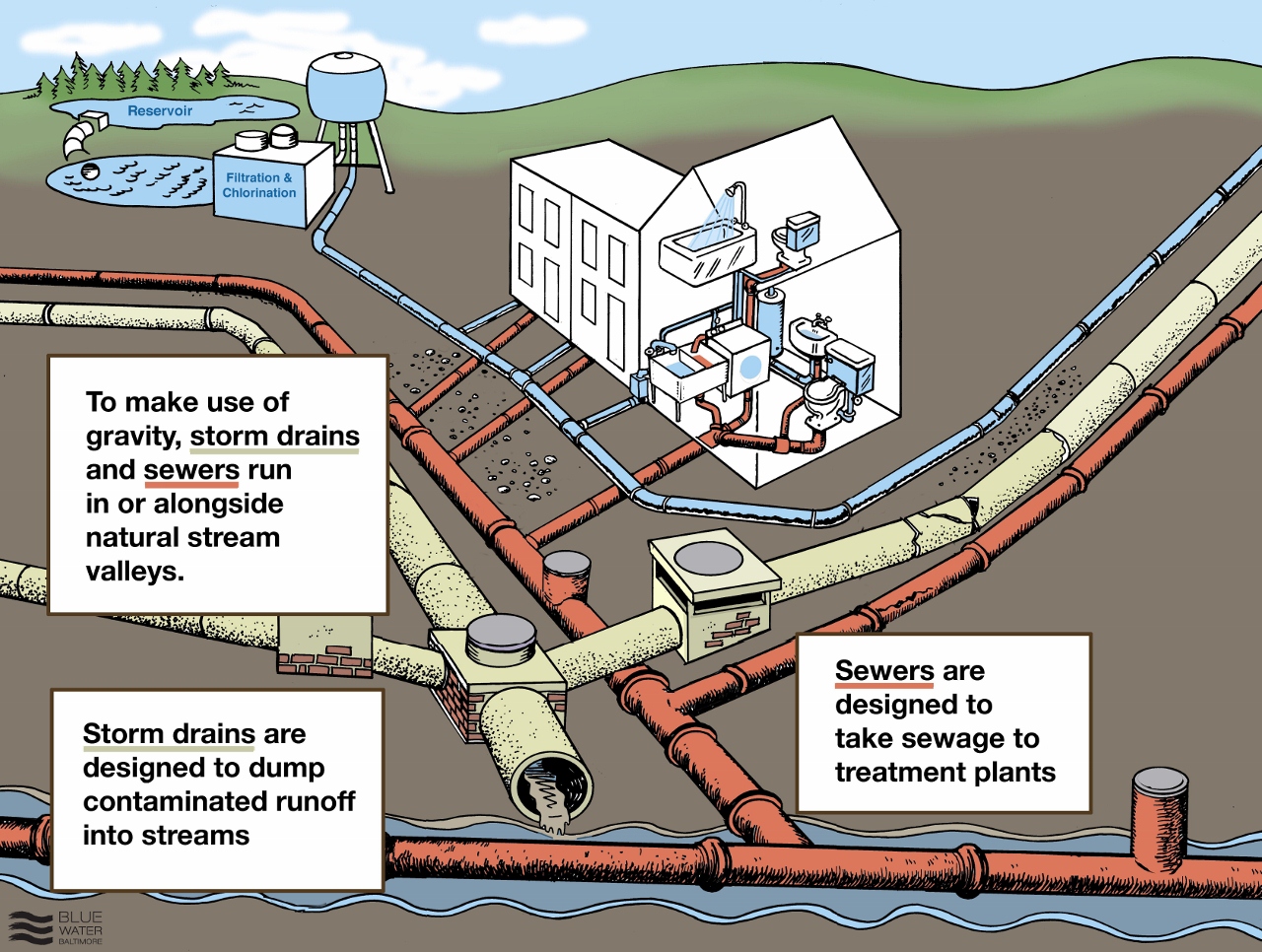
Unfortunately, our pipes are decades old and starting to wear down. Our storm drain pipes and sewage pipes are leaking and many have tree roots grown into them, blocking the flow of the water. However, large pieces of trash, pollutants, and chemicals still make their way into our storm drains and through our pipes in large quantities. And those storm drains empty out into the Baltimore Harbor.

What do we do?!? If we are more mindful of ourselves and of our environment we can do a whole lot to help preserve and promote the health of our water and the health of the Chesapeake Bay. By not littering, and encouraging others not to litter, we reduce the amount of trash that is carried away and into our bodies of water. By gardening and promoting depaving of our communities and schools we contribute to the amount of rain water that gets absorbed into the soil instead of washed away through streets and down storm drains. By cleaning up our communities and making them beautiful, we are helping to keep our Bay, and all of our water, beautiful and clean.

To take solid steps towards protecting our watershed, you can contact Blue Water Baltimore, the Non-Profit Organization that works in Baltimore City and County to clean water in Baltimore's rivers, streams, and harbor. They always have great tips such as this page to help you learn how to reduce storm water pollution. They also have a Water Audit program - completely free! If you sign up someone from Blue Water Baltimore will come to your home and give you educated suggestions on ways to improve any negative storm drain runoff from your property. Sign up Here to receive more information.
And remember that greening in your neighborhood helps! Find out about depaving, starting a community green space, starting a garden, or volunteering to help others do these things at any of the following organizations and agencies,
The Parks & People Foundation,
The Community Greening Resource Network,
Baltimore Green Space,
Civic Works,
Power in Dirt,
Baltimore Recreation and Parks,
Department of Public Works (Cleanups),
Department of Transportation (Depaving)
All images provided by Blue Water Baltimore (Thanks, friends!). Please visit their website for even more information on watersheds, Baltimore's water system, and what you can do to help!
Monday, December 19, 2011
Workshop!

Join Baltimore Green Space to learn how to make your community garden, pocket park, or other urban oases last forever! Baltimore Green Space works to protect these green areas and other open spaces created and cared for by city residents.
At the request of community groups, Baltimore Green Space acquires community-managed open spaces and provides support to those who care for them. This allows communities to ensure that their urban oases will endure without taking on the responsibilities of acquisition, ownership, and liability.
Join us to learn about the processes and benefits for your neighborhood. The evening will also feature a "virtual tour" of some of the loveliest community green spaces throughout Baltimore.
When: Wednesday, January 18th, 6:30 p.m.-8:30 p.m.
Where: HEBCAC
1212 North Wolfe Street
Baltimore, MD 21213
Please RSVP if you can by contacting:
Galadriel Rosen-
grosen@hebcac.org
443 524 2800 ext. 126
or
Miriam Avins
Executive Director
Baltimore Green Space
443-695-7504
miriam@baltimoregreenspace.org
Wednesday, November 16, 2011
Tree Baltimore
We have had our first tree delivery!
Now three red maples will be planted at the corner of Montford and McElderry in partnership with
Banner Neighborhoods and the McElderry Park Community Association.
Thank you Tree Baltimore!


Dr. Rayner Browne Elementary School

Dr.Rayner Browne Elementary School revitalized their chess park garden on the corner of Chase and Montford on Saturday November 5th. The event was held for the James W. Rouse day of service and the school, the residents, Parks and People, Elev8, American Communities Trust, HEBCAC, and Power in Dirt all busied themselves to make this day full of sweat and smiles! The greenspace was expanded to include room for a raised bed vegetable garden that students can use to sprout to their hearts content. A new horseshoe pit was created too. Many folks from little ones to Bobcat drivers manned their post. The central pathway was reworked, new beds dug for planting, trash removed, the chess tables refinished, trees planted, and on and on! Volunteers arrived bright and early on a Saturday and had their bellies filled with a lovely lunch and also a BBQ (two meals!)
Thank you so much everyone! I can't wait to see how this project will grow!
 Dr Eason, The Schools' principle with rose bushes~
 A Horseshoe pit is formed!
 A Bobcat machine digs a new space for plants~
 Artist Ivy Parsons weather seals the chess tables she built in collaboration with the residents~
 Peanut, a resident, reworks the stump on which the tables are built~


Monday, November 7, 2011
C.A.R.E Foundation and Baltimore City Vacant Lot Transformation


What obstacles have you faced?
What are the benefits you've found?
What is your favorite plant in your garden?